Gleichschaltung of Schools – A Russian parable: a discussion by Project2022 in cooperation with Filmhaus Köln and the Lew Kopelew Forum
24 June 2026, 17:00–18:30
In the Foyer of Filmhaus Köln, Maybachstraße 111, 50670 Cologne
The integration of media, academia, universities and schools into Russia’s party line has been evident well before 2022. This is a process that began with the closure of NTV in 2001 and has continued unabated ever since – manifesting through the persecution of independent media such as Novaya Gazeta to the banning and criminalisation of human rights organisations such as Memorial and OVD-Info. The systematic suppression of academic and educational freedom at universities and schools began somewhat later: from 2014 in the Russian-occupied territories of Ukraine, and from 2022 in Russia itself. Since 2012, Russian criminal law has also provided for the designation of “foreign agent”, and since 2015, that of an “undesirable organisation”. These labels can be applied to representatives of any profession or social group who, in the view of the Russian state authorities, are under foreign influence or threaten the Russian social order. Pavel Talankin was similarly branded a “foreign agent” in the wake of the Oscar prize.
The discussion aims to prompt broader questions: How should journalism, schools, art and scholarship engage with the “black box” of Russia? What purpose does speaking about Gleichschaltung serve – and where are its limits? What ethical standards apply in dealing with sources, in protecting witnesses, in engaging – or not engaging – with the precise circumstances of Russian war crimes in Ukraine? And what “lessons” can – or should – other societies draw from this story, which is still unfolding before our eyes, in which we ourselves may somehow be implicated?
The film – and the case – of Pavel Talankin constitutes a peculiar parable that offers a fresh perspective on Russia and provokes very different reactions. It is about normality, about the banality of conformity in today’s Russia – but also about the courage and the room for manoeuvre that an ordinary person can nonetheless find in order to resist not only the Kremlin’s version of reality, but also the quieter forms in which one’s own otherness can be refused recognition in a society.
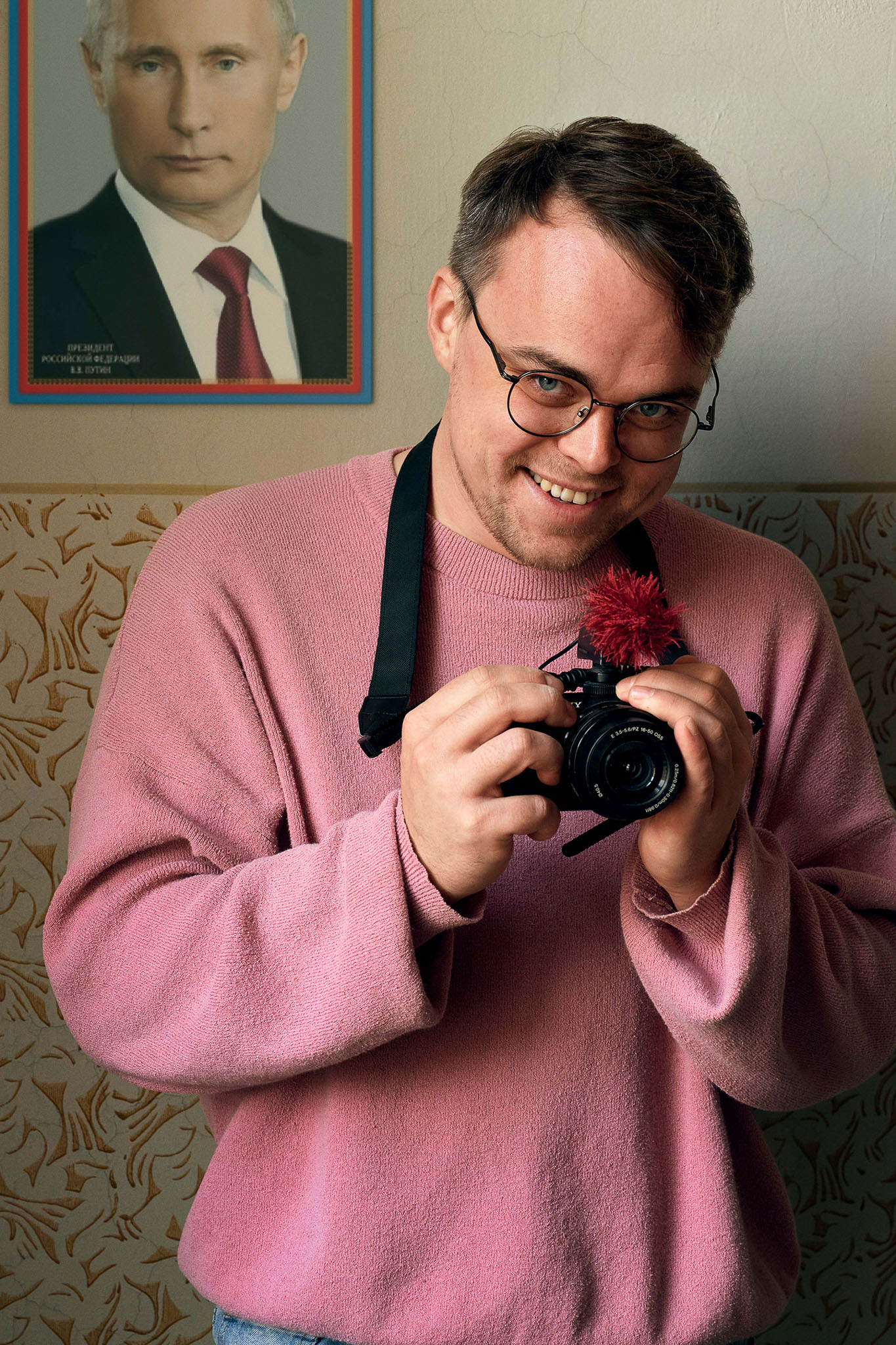
The event will open with a conversation with Pavel Talankin, the director and protagonist of the documentary film “A Nobody Against Putin”.
About the Speakers
Dina Gusejnova was born in Moscow and completed her secondary education (Abitur) in Bremen. She received her doctorate from Cambridge and, following postdoctoral fellowships at Stanford and Chicago, is now Associate Professor in the Department of International History at the London School of Economics and Political Science. She is a Fellow of the Royal Historical Society and the author of, among other works, European Elites and Ideas of Empire, 1917–1957 (Cambridge UP, 2016). In autumn 2026 she will publish the article “Spengler’s ‘Zeitenwende’ Today: On the Political Use of a Concept from the Second Morocco Crisis (1911) to the Second Ukraine Crisis (since 2022)” (Heise and Öhlschläger (eds.), Brill, 2026), and (together with Friedrich Cain) the edited volume Academia and the People: Universities, Knowledge Communities, and Dissent in Central and Eastern Europe, ca. 1900–2025 (transcript). In 2021 she co-founded the University of New Europe with colleagues, a civil society initiative supported by the Dutch Media Foundation. This collaboration also gave rise to the idea of the Eastern Academic Alliance, now an EU-funded network in which Gusejnova, together with Dorine Schellens (Leiden), leads Project2022, a research- and education-oriented initiative (Project2022.eu). The group recently published a study on Russian schools since 2022 in the Russian Analytical Digest.
Tamina Kutscher is a journalist, Slavicist and historian who has been working on culture, media and society in Russia and Central and Eastern Europe for more than 20 years, also as a moderator, editor and member of various specialist juries. From 2016 to 2023 she was editor-in-chief of “dekoder – Decoding Russia and Belarus”. During this time the media and academic platform received multiple awards: the Grimme Online Award (2016 and 2021) and the Karl-Wilhelm-Fricke-Preis (Special Prize, 2021). Previously, Tamina Kutscher worked for six years as an editor and project director at the international journalist network n-ost, which took her to numerous countries in Central and Eastern Europe as well as to Central Asia (Kazakhstan and Kyrgyzstan). As co-founder of #Unfollow Propaganda, she investigates together with Mandy Ganske-Zapf where Russian propaganda originates, through which channels Russian disinformation reaches Germany, where it finds particularly fertile ground, and why.
Alexey Uvarov is a historian and political scientist. Dr Uvarov works on the politics of history in present-day Russia and Eastern Europe. After studying at Lomonosov Moscow State University he also worked there in the field of international academic cooperation. In 2022 Alexey Uvarov left Russia in protest against the Russian war of aggression. He is now classified as a “foreign agent” in Russia, a consequence of his condemnation of the war and his publications in Russian exile media. In these publications he analyses, among other things, how history is used in Russian propaganda. He completed his doctorate at the University of Bonn in 2024. His dissertation examined how narratives about the Soviet Union and the Russian Empire are used to legitimise present-day Russian politics. His doctoral studies were made possible by a Scholars at Risk fellowship from the Gerda Henkel Foundation. He currently works at Ruhr University Bochum. His texts have appeared, among other places, at dekoder, Meduza and Riddle Russia, as well as in other leading outlets covering Russian politics and history. For Meduza and The Insider he recently analysed new Russian history textbooks, co-authored by Vladimir Medinsky, adviser to the Russian president and former Minister of Culture, and Anatoly Torkunov, rector of MGIMO, the Moscow State Institute of International Relations.
Felix Riefer is a political scientist specialising in International Relations and Eastern European Studies. He completed his doctorate at the University of Cologne in 2020 and is currently a postdoctoral researcher at the University of Freiburg. His research focuses on Russian foreign policy, the interplay between domestic and foreign policy, the roles of elites and institutions, and political and social developments in Eastern Europe. He also examines Russia’s transnational anti-liberal strategies targeting Russian-speaking communities in Germany and worldwide, as well as questions of diaspora politics, identity construction and the projection of illiberal norms. Dr Riefer is a member of the Academic Commission for Germans in and from Eastern Europe, Siberia, Central Asia and the Caucasus (WKDO), of the Advisory Board of the Lew Kopelew Forum, and of the Editorial Board of the “Journal of Soviet and Post-Soviet Politics and Society”.